
Nov 7 2025
By: John Mannes
The Virality Trap
There’s a growing belief that in crowded markets, the only way to stand out is to go viral. Attention feels like the new oxygen, it's the difference between being overlooked and being discovered. And sometimes that’s true: a single launch, demo or post can change a company’s trajectory overnight.
But virality on its own doesn’t last. Doing it once can open a door. Doing it again and again, while still building, shipping and learning, requires something deeper. Sustainable virality isn’t charisma or luck; it’s engineering. It comes from the systems that make distribution, iteration and learning compound. Without that foundation, it’s easy to end up optimizing for moments instead of momentum.
Opaque ≠ Competitive
There is also a general belief (especially pervasive amongst investors) that most AI markets are competitive. That competition is, in many cases, the root of desiring virality as a differentiator in the first place.
Lots of markets appear crowded with dozens of players and indiscernible overlap, but below the surface, they’re not actually competitive, they’re just opaque.
A competitive market is one where players fight for the same customer in nearly zero-sum dynamics: pricing pressure, inflated ad costs, interchangeable products — commodity. An opaque market looks just as busy from the outside but operates differently. Differentiation is buried under the surface — hidden in how teams learn and make decisions and how they build products. Nobody has won, nobody is actually competing.
Very few AI products today are robust and transformative enough to claim venture-scale economics. But the bet is that, in the near future, they absolutely will. The question is who will get there first — and surrendering to the opacity is a cop out that almost certainly guarantees you’ll miss out on the value creation at the end.
The Shift from Speed to System
The idea that teams make a difference in competitive markets is not novel. Execution and clock speed always matter, moving fast with the best people is always differentiating, see our research on these exact points. But speed has evolved from raw speed to system design. The question now isn’t just who drives fastest, but how they’ve built their car.
The teams that consistently earn attention aren’t just good at marketing — they’ve built internal architectures that make learning and distribution compound. Their product and communication loops are interconnected. Every launch feeds data back into the system; every experiment refines process; every success leaves behind infrastructure that makes the next one easier.
Companies are built on AI-first operating systems to automate and accelerate nearly every part of their business. Engineering teams rely on coding assistants and automated testing to stay in build mode with fewer people. Customer support and success functions use AI to draft responses, synthesize sentiment and surface insights in real time, while user research and content moderation are handled by specialized automation tools. On the go-to-market side, AI-driven SEO, ad optimization and influencer management have replaced what once required large marketing teams. We have companies building the future in nearly all of these spaces.
The result is organizations that are lean, adaptive and compounding in efficiency — where process and tooling are becoming as much of a moat as product itself.
The Founders Who Build Like This
These founders tend to share a familiar set of traits:
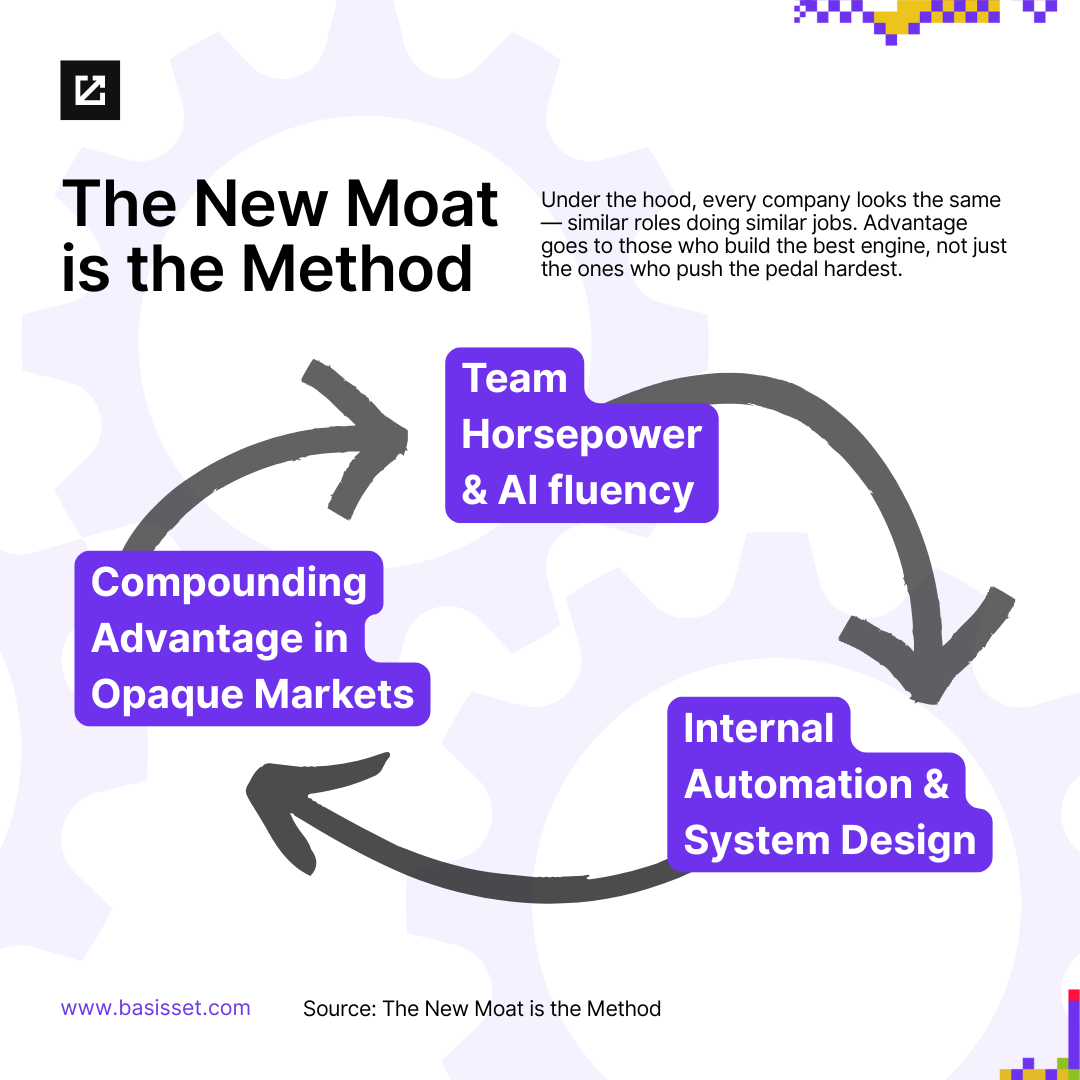
Over time, these behaviors translate into technical leverage — tighter feedback loops and faster iteration. Companies evolve like well-tuned systems: self-observing and self-optimizing. The method becomes the moat.
The Quiet Advantage
Virality done right ought to be a reflection of how well a company’s systems work, it’s not a substitute for them. The goal is to take outcomes that are primarily luck and convert them into automated and repeatable systems. And as these systems compound, so does product quality, growth and differentiation. This often invisible infrastructure enables great founders keep standing out long after everyone else burns out.