Trade Finance

Financial tools to reduce risk and facilitate trade. Trade finance responsibilities are typically handled by large financial institutions (banks). These responsibilities can include Letters of Credit — a promise of payment produced by a bank on behalf of a buyer, insurance products and factoring products. In the context of this research, trade finance includes all the movement of documents, capital and goods that are part of an import/export transaction.
Letters of Credit specifically cover approximately 1/6th of total trade volume. Out of approximately $8 trillion in global trade, $2.8 trillion was constituted by Letters of Credit. Trade insurance constitutes another $1.7 trillion in value. In the USA, 14% of trade volume involves Letters of Credit. In China, 47% of trade volumes involve Letters of Credit.
Reported trade finance assets by selected banks
- HSBC (United Kingdom): total assets: US$2,556bn; total finance assets: US$166bn; total finance as % of total assets: 6.5
- Standard Chartered (United Kingdom): total assets: US$599bn; total finance assets: US$110bn; total finance as % of total assets: 18.4
- Bank of China (China): total assets: US$1,878bn; total finance assets: US$107bn; total finance as % of total assets: 5.7
- Industrial and Commercial Bank of China (China): total assets: US$2,456bn; total finance assets: US$86bn; total finance as % of total assets: 3.5
- Deutsche Bank (Germany): total assets: US$2,800bn; total finance assets: US$74bn; total finance as % of total assets: 2.6
- JPMorgan Chase (United States): total assets: US$2,266bn; total finance assets: US$35bn; total finance as % of total assets: 1.5
- UniCredit (Italy): total assets: US$1,199bn; total finance assets: US$18bn; total finance as % of total assets: 1.5
- Banco do Brasil (Brazil): total assets: US$523bn; total finance assets: US$16bn; total finance as % of total assets: 3.1
- Intesa Sanpaolo (Italy): total assets: US$827bn; total finance assets: US$8bn; total finance as % of total assets: 0.9
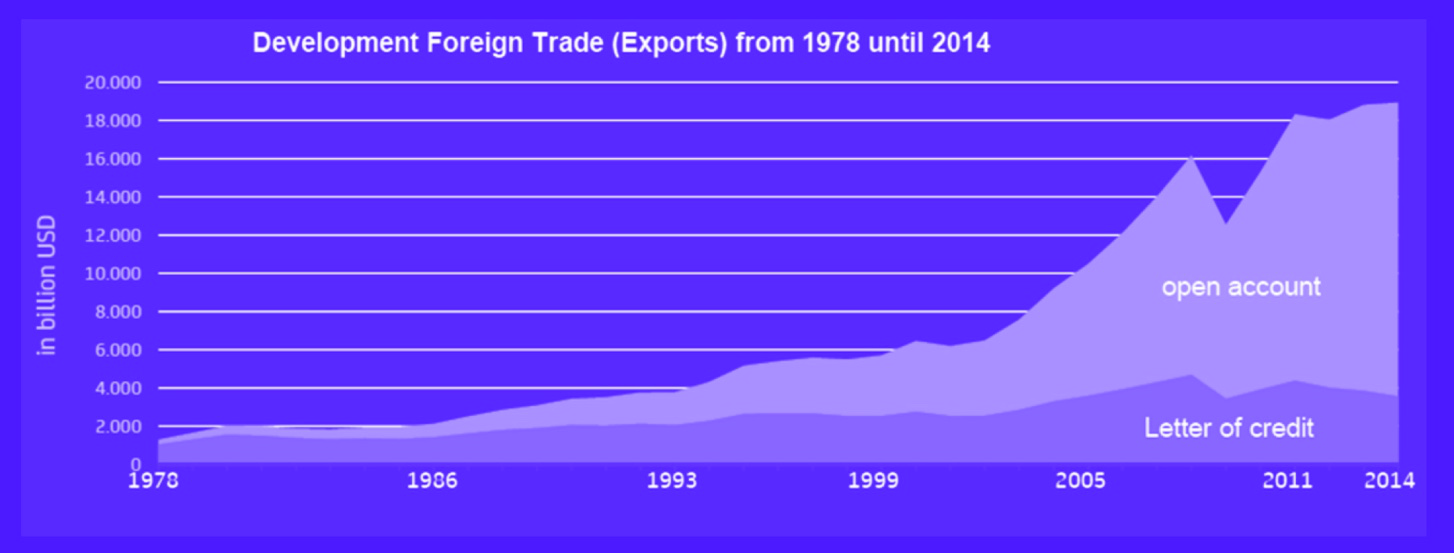
It is difficult to quantify decreases in the use of Letters of Credit specifically but it is thought that the use of them has been decreasing as long term trade relationships continue to develop and risk is reduced throughout the global trade system. That said, overall use of trade finance is increasing, being driven by increasing global trade.
Letters of Credit play an important role in the exchange of commodities, particularly because commodities serve as fantastic collateral that is easy to verify.
Default and loss rates within trade finance, among large banks, is low. Write-off rates on Letters of Credit are typically lower than 3%.
Key concepts
Actors
- Importer: Entity buying goods
- Exporter: Entity selling goods
- Banks: Entities facilitating capital and documents associated with goods, often intermediaries
Objects
Documents
- Bill of Lading: An agreement between an exporter and a shipping company to deliver a good from one place to another. The holder of this document has title to the respective goods.
- Letter of Credit: Effectively a promise from an importer’s bank to an exporter’s bank that payment will be guaranteed assuming certain negotiated terms are met.
- Bank Payment Obligation
Money
- Payment from the buyer to the seller
Goods
- Items being purchased by the buyer and delivered by the seller/shipper
Types of trade finance arrangements
Advance payment
Immediately following a sales contract, money is transferred from a buyer to a seller, prior to any goods actually being shipped. This kind of arrangement is very simple but only works when the buyer trusts the seller to deliver. Competition in the market typically makes this arrangement rare because it heavily favors the seller and if there are multiple sellers competing, providing more favorable payment arrangements is an easy way to create competitive differentiation.
- Sales contract
- Payment
- Shipment of goods
Open account
Immediately following a sales contract, goods are shipped by the seller to the buyer. The seller trusts the buyer and has entered into a relationship with the buyer with payment terms. There is no third party guaranteeing payment. These are the most favorable terms for a buyer and can be very risky for a seller.
- Sales contract
- Shipment of goods
- Payment in 30-60-90 days
Documentary collection & documentary credit
Document against payment / Document against acceptance / Letter of credit
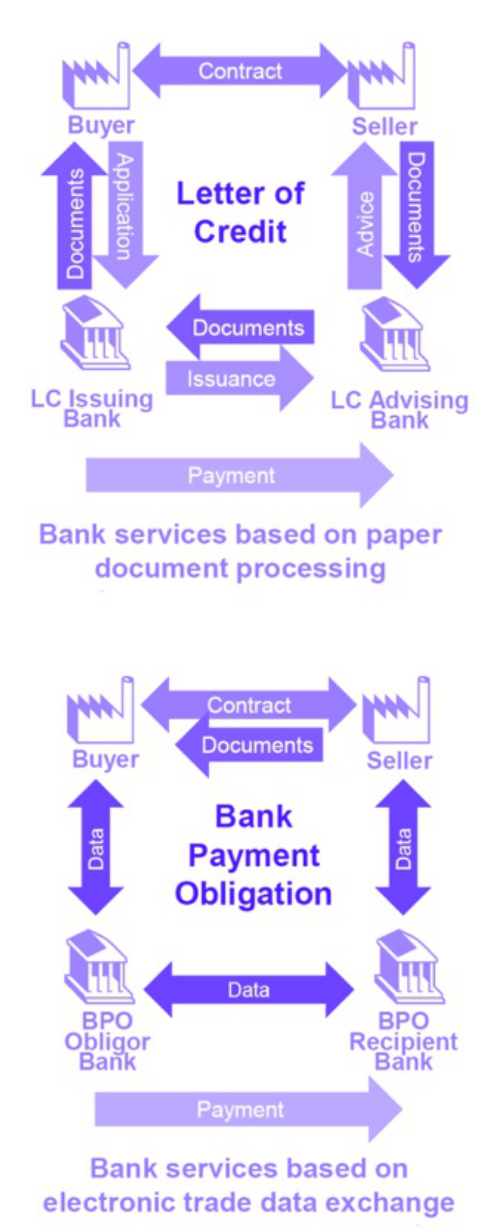
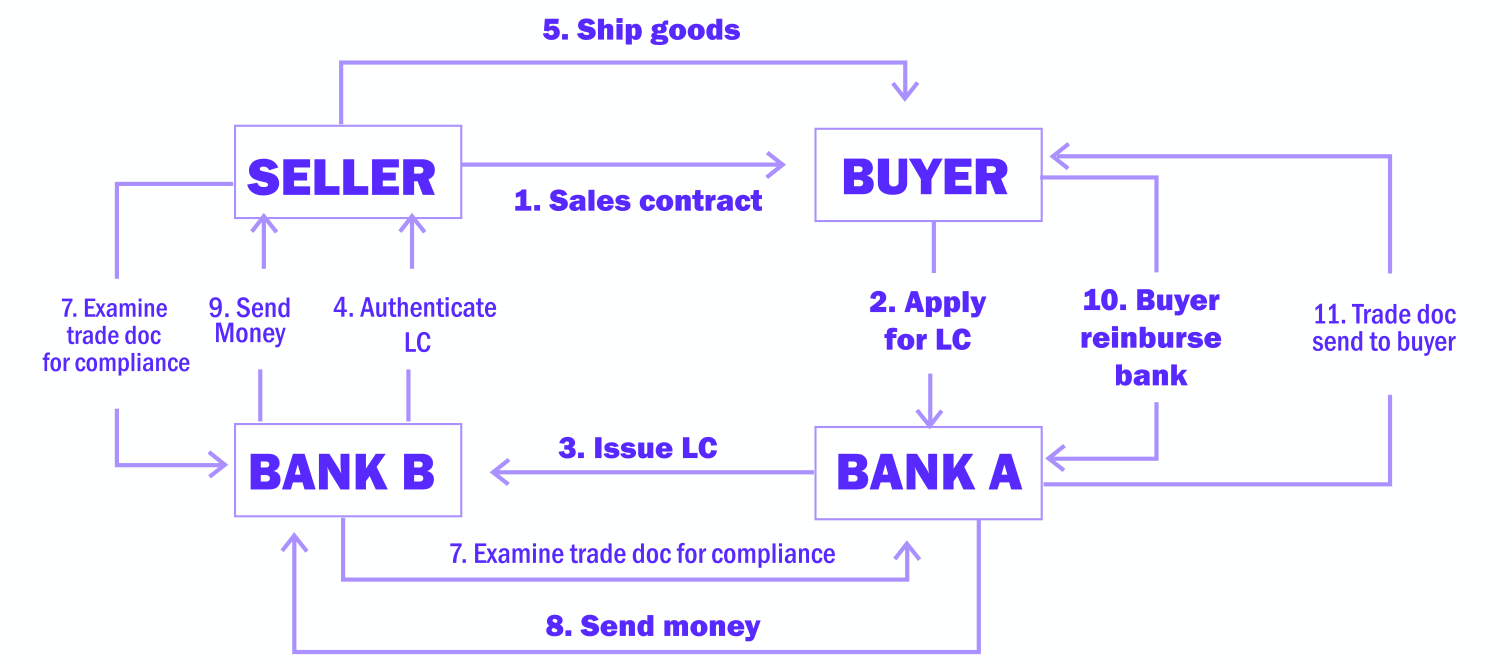
There are many flavors of Letters of Credit but the fundamental principle is that a bank is stepping in as an intermediary to reduce risk and information asymmetries between buyers and sellers. In a documentary credit transaction, documents, goods and capital are treated as three separate entities.
After a sales contract is agreed upon, a buyer applies for an LC from his respective bank. Upon issuance, the LC is issued to the seller’s bank. The LC stipulates that a buyer’s bank will guarantee payment for goods, assuming some agreed upon stipulations are met. This allows the seller to feel comfortable shipping goods in advance of payment when he cannot fully trust a buyer to make good on payment.
Once the LC is forwarded to the seller and terms have been agreed upon, the seller goes ahead and ships the goods to the buyer. Of course at this point the goods are still the property of the seller, because the seller is in possession of the Bill of Lading.
Next, trade docs (including the Bill of Lading) are sent from the seller, through the seller’s bank to check for compliance with the LC, and ultimately on to the buyer’s bank. Upon performing the same compliance checks, the buyer’s bank forwards money to the seller’s bank on behalf of the buyer. The buyer’s bank holds the trade documents until the buyer can reimburse the bank (this can happen a variety of ways or not happen at all).
After the terms of the LC have been met by all parties, the bank forwards the trade docs to the buyer so he can take custody of the goods at the port.
In some variations, i.e. documentary collections — payment is not guaranteed by the bank, but banks still manage the flow of documents between both parties. This is an important legal consideration that can help in the event of a dispute between two parties in a court setting. Documentary collection is a much less expensive service from a bank that mitigates less risk but can still be desirable.
Issues with the LC process
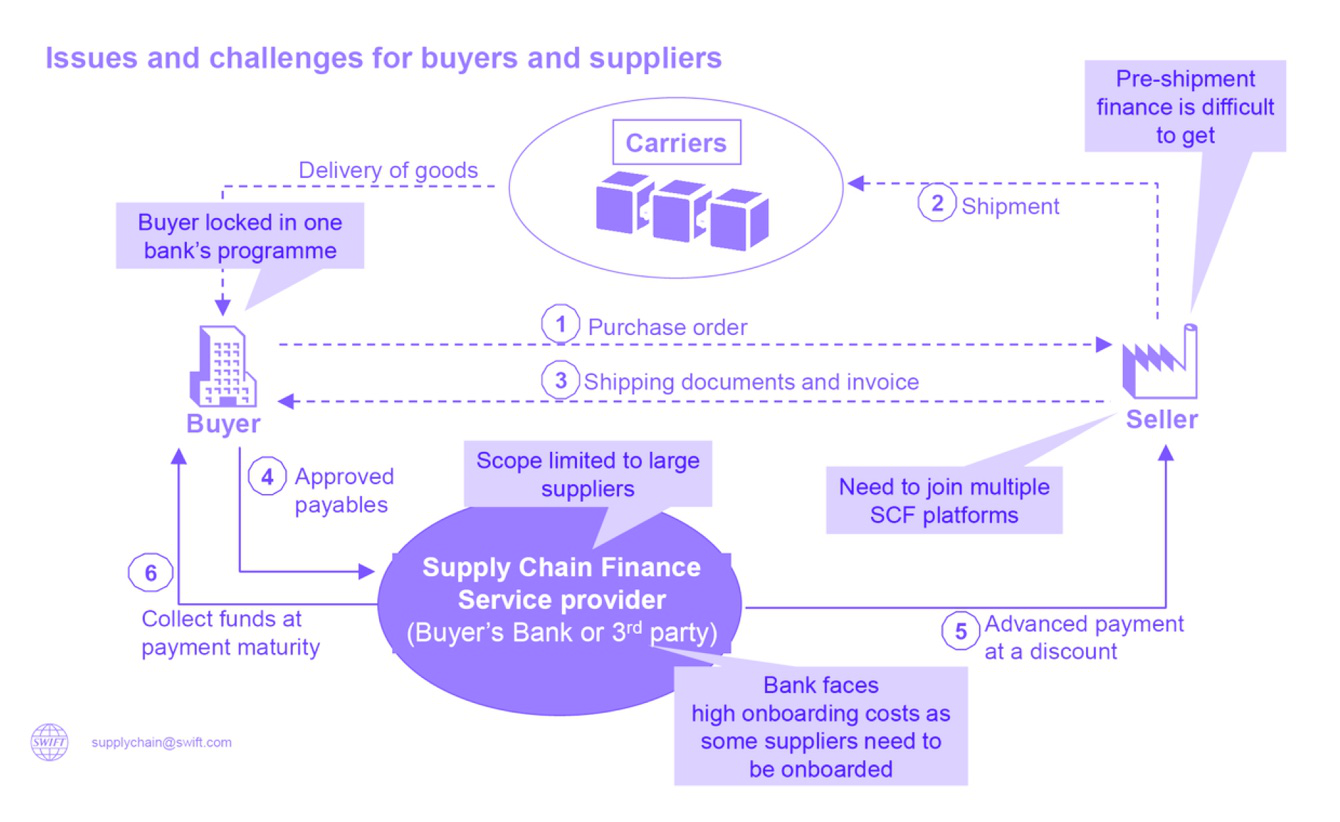
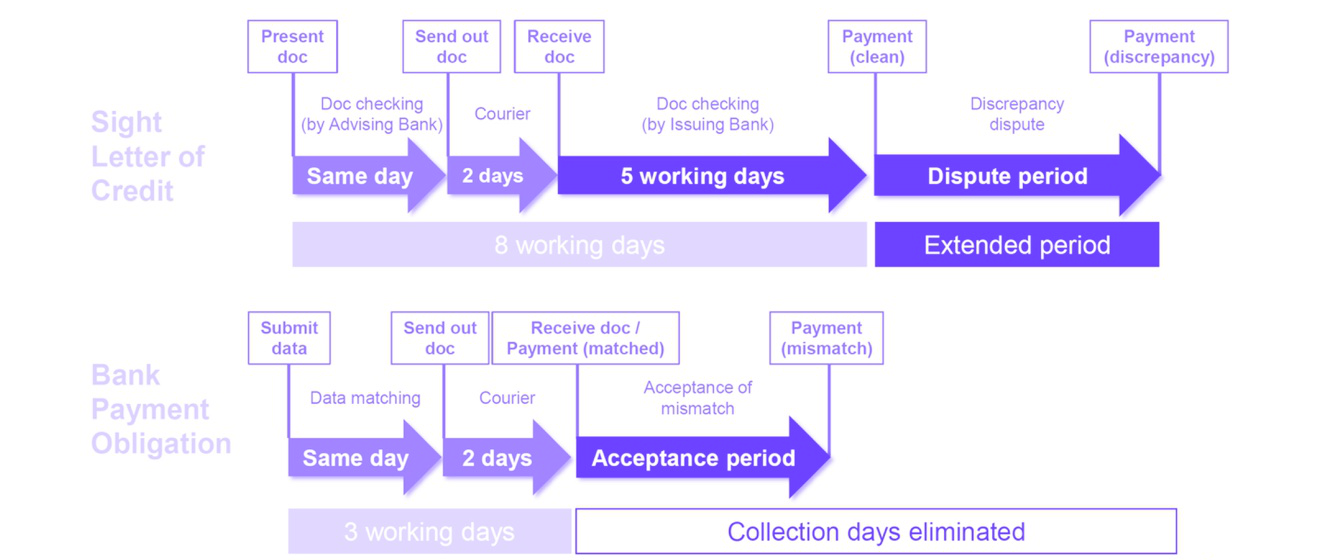
The chart above outlines many of the issues with LCs but to expand on a few of the more interesting ones...
The most important issues
- Sellers have to manage multiple supply chain finance (SCF) platforms from every bank that their customers work with. Each platform is proprietary with its own document management processes. Some customers might be reputable enough to have open account privileges, but this would need to be managed separately. See section below on SWIFT MT 798.
- Pre-shipment finance and pre-production/shipment financing for vendors is challenging for banks to underwrite. Banks are very good at post-shipment finance, it’s much easier to underwrite. The issue is there is less in terms of collateral in the pre-shipment world — i.e. underwriting working capital to produce an order for a customer. Purchase order financing requires a level of understanding of the likelihood a buyer will make good on a purchase and the likelihood that a supplier will be able to deliver on time. Factories sit on data that would make these transactions easier to underwrite (i.e. manufacturing cycle time, on-time deliveries, etc) but traditionally producers have been unwilling to share this data with banks. It’s unclear if this is a result of logistical difficulties around sharing data or a more philosophical opposition.
- Even with SWIFT protocols, the level of integration between banks (and corporates) is extremely high. This leaves a relatively untapped mid-market that can’t take advantage of off-the-shelf tools and must manually use disparate bank SCF portals.
Related services
Factoring
A product where a financial institution will purchase an invoice and advance capital to a supplier for a spread. Typically the financial institution then takes on the responsibility of collecting the money from the buyer. The financial institution will typically provide about 80% of the value of the invoice up front. After the collection of payment occurs, the financial institution will then forward the additional 20% (less the spread) to the supplier.
Trade credit insurance
Insurance for invoices in the event buyers do not pay. Effectively a proactive step a supplier can take if a buyer doesn't pursue an LC. This protection comes at a cost for suppliers.
Trends
The rise of originate to distribute
In the last decade, there have been attempts by banks to offload risk held in various trade finance instruments to outside investors through securitization. These efforts however haven’t led to many changes because trade finance instruments are low risk and thus low yield.
With such narrow spreads, there isn’t a lot of room for another party to share in the ROI. It’s unclear if an MGA-style model could work for distributing trade finance services down market.
Attempts by logistics players to play in trade finance
With UPS, Maersk and Flexport all now providing trade finance services, pressure is being put on banks as well as incumbents and traditional 3PLs/Freight Forwarders. UPS recently partnered with Kabbage, an Atlanta-based small business loan providing startup with the goal of closing this gap in mind.
Bank payment obligations & MT 798
Identical in value proposition to a Letter of Credit but without the physical transfer of documents. Requires data integrations between parties but much faster with SWIFT protocol.
MT 798 is a new SWIFT protocol that allows corporates to communicate directly with banks through ERP integration. The main benefit is that traditionally each bank had its own portal for managing operations, capital and document flows. MT 798 creates the potential to remove some of this operational complexity by having a single protocol that can be used for communication across all parties.