Trucking Operations

- Trucking is the largest component of the transportation market. 60 percent of industry revenues go to trucking companies.
- As land values increase and warehouses become scarce, the US is investing in inland port and drayage operations.
- 80 percent of trucking operations are either local or regional
State of trucking operations
Dominance of contracting
With the passage of the Motor Carrier Act of 1980, the short haul trucking industry began to rapidly move away from unionization and into independent contracting. Today over 400 independent trucking companies service the Nation’s largest port, the Port of Long Beach. This stands in contrast to the heavily unionized container shipping and dock worker segments
This fragmentation has complicated many supply chains and put pressure on drivers to source enough contracts to ensure trucks remain full on all legs of a trip. Truck ownership is a significant expense for drivers and supplying warehouse space for transloading is a challenge in cities with high land values.
Carriers forgo chassis
Maersk decided to end ownership of its speciality chassis around 2010. This caused the industry to adopt similar practices to streamline and push profits up. However Maersk simultaneously launched a rental company to buy its chassis and rent them to users of any ocean carrier. While the chassis didn’t completely go away, the need to procure them has become a massive annoyance for drivers.
Similarly, containers are inefficiently allocated across the US as they are often rented for periods of time and taken off the market or inefficiently geographically distributed without sufficient return loads
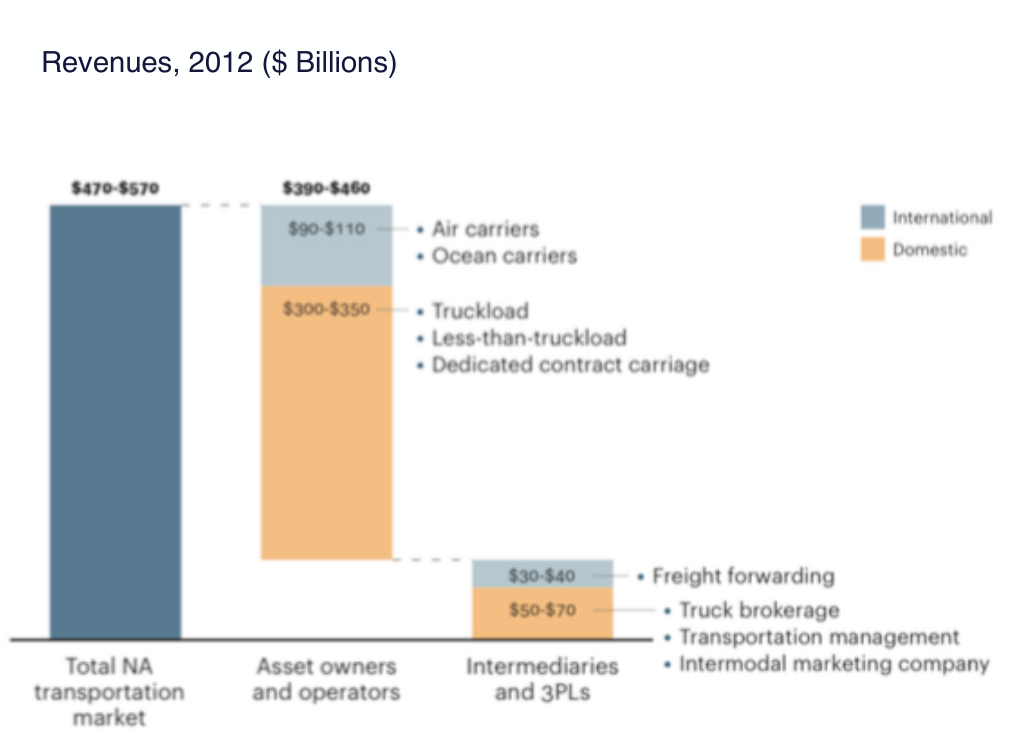
Freight forwarding on rise
Because of the increasing complexity of supply chain management, startups and legacy companies alike have moved into the freight forwarding space. Forwarders manage the entire door to door delivery process, negotiating for container shipping prices, short and long haul trucking prices and warehousing space.
Another benefit of freight forwarding is that it allows more efficient consolidation of goods to better utilize existing transportation resources. It’s hard to negotiate with Maersk without bulk contracts.
High level trucking workflow
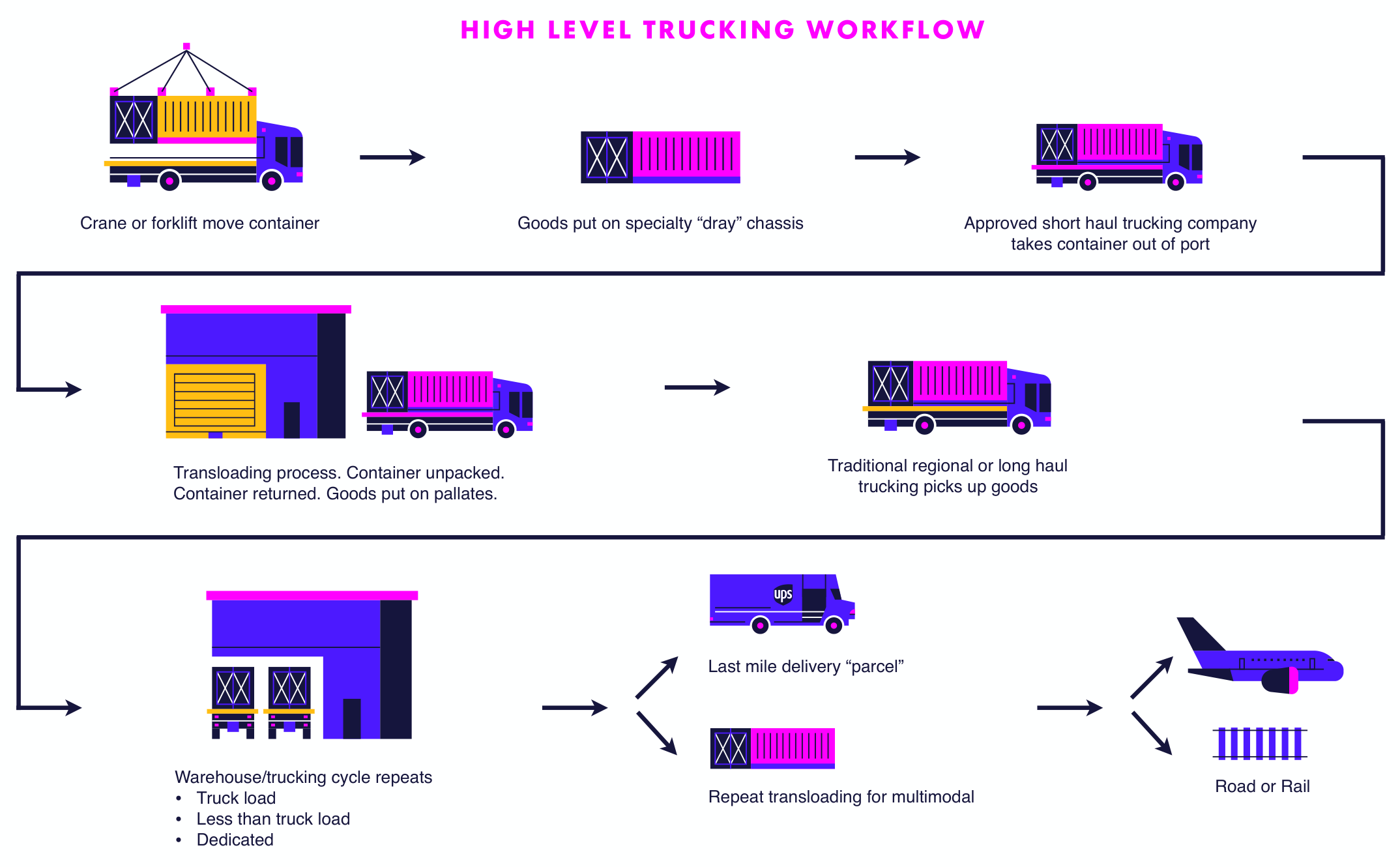
Truckers are at the mercy of demand, resources and infrastructure
- J.B. Hunt Transport Services
- YRC Worldwide
- Con-way
- Swift Transportation
- Schneider National
The US trucking industry roughly breaks down into long haul and short haul trucking. A majority of transportation is short haul (under 250 miles) and managed by small providers.
This further breaks down into truckload (TL) and less than truckload (LTL) shipping. In TL, an entire truck is commissioned for a job and in LTL part of a truck is used. Both of these differ from parcel delivery where typically only one package is delivered to each customer. Some large companies use dedicated trucks that are leased with custom branding.
A truck cab is the largest investment for a small trucking company. Trailers are interchangeable depending on what is being hauled. This defines the process of sourcing shipping containers and chassis.
Logistically the hardest part of trucking is optimizing routes and resource allocation for small LTL companies. Often a truck driver would rather leave space in his/ her truck than go out of the way by too many miles to pick up a second load. Truck drivers are paid by the mile.
The trucking tech stack
Operations
- TMS — Transportation Management System (resource planning) (Mercury Gate)
- Fleet management
- Remote diagnostics
- Tracking software
- Delivery time prediction and load optimization
- Automated carrier assignment and billing
- Delivery management
- Fuel optimization
- Driver management
Hardware
- Truck (Tesla)
- Chassis
- Tracking and loading IoT
- Autonomous stack
Customer and driver facing
- Marketplace (360)
- Tracking
- Freight board (DAT)
- Driver auditing / hours
- Payroll
- HR and hiring
The marketplace revolution
The biggest technological change in trucking is the move to digital marketplaces. This move was catalyzed by deregulation in the 1980s that led to the emergence of small trucking companies.
The proliferation of owner/operator trucking companies coupled with the rise of Uber created a hotbed for venture capital investment in startups promising to use data to match drivers with shippers.
Convoy is leading the charge in this space with many companies attempting to follow. This is playing out similar to the rise of Uber where local competitors attempted to scale in smaller geographies but so far only the US and China have sustained large players.
There remains opportunities to simplify the marketplace for shipping containers, chassis and other specialty hardware but the market is smaller and more stratified than the broader shipping market so we are unlikely to see much activity in the space despite the fact that it’s deeply needed. The same is true for warehouses as a service — though this is a larger market, it is still highly capital intensive.
The future of TMS
Trucking companies are moving away from centralized transportation management systems (TMS). The slow verticalization of specific pieces of software creates SaaS opportunities, though most use cases are either too niche or too general to gain adoption and achieve defensibility.
There are opportunities for using machine learning to assist in the allocation of trucks and goods. Models can be adapted to better predict delays and close uncertainty gaps.
Document and workflow management is an attractive category because of the size of the market opportunity. Many of the same documents are used across shipping, trucking and customs processes. The space is generally more stratified however so it is harder to enter given significant integration burdens and challenges around OCR for variable documents like bills of lading.
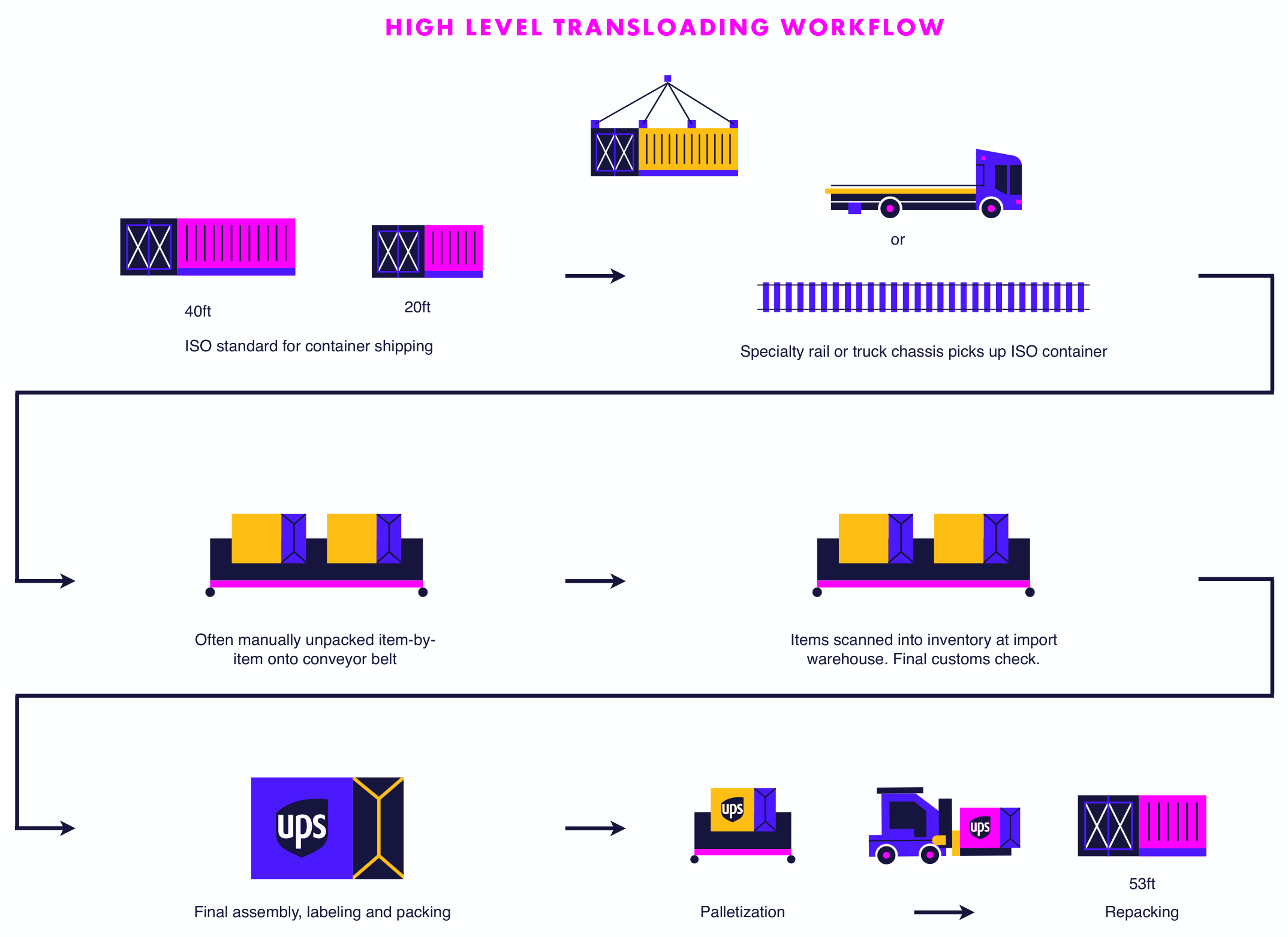
High level transloading workflow
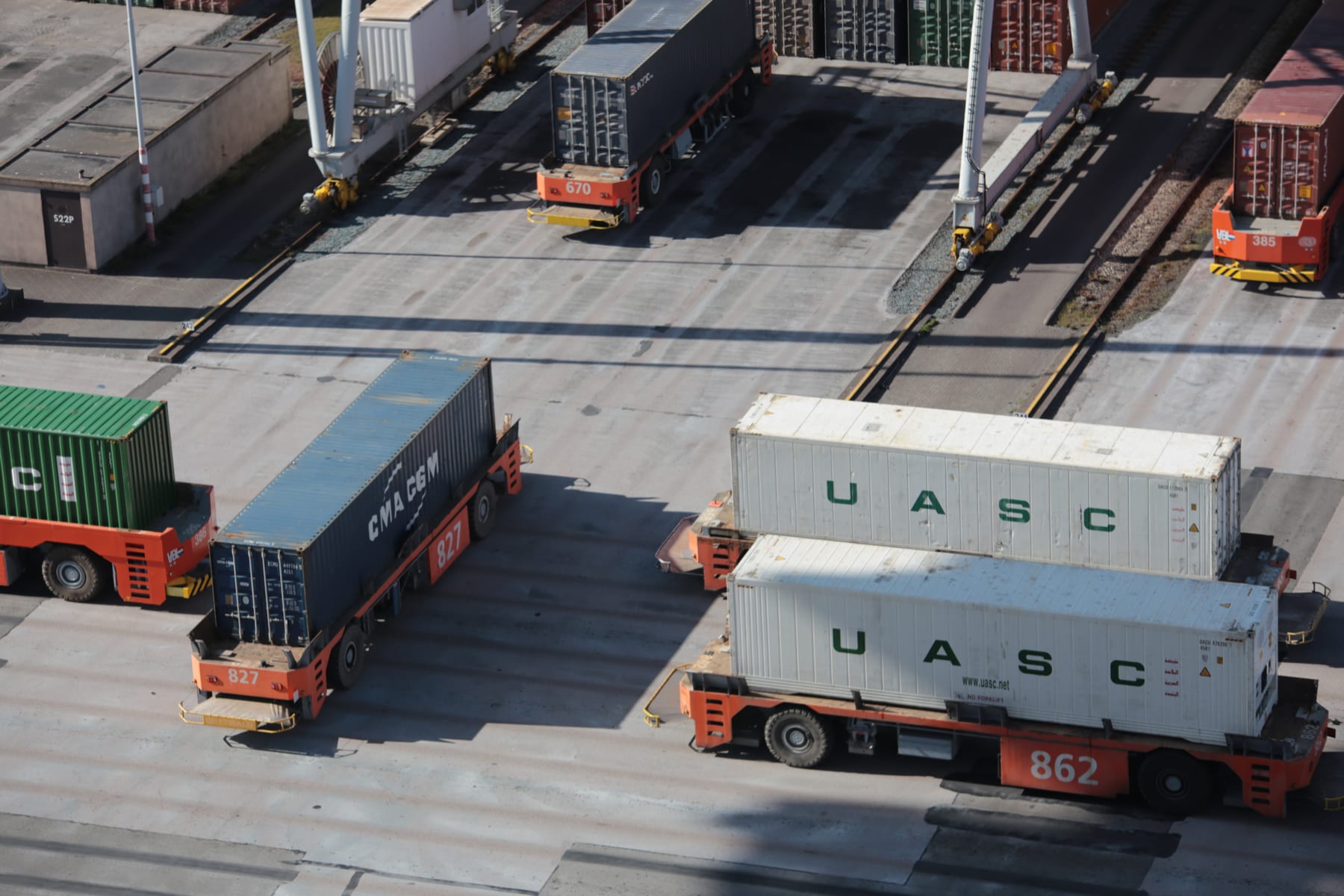
Transloading is moving inland
The Transloading process is the process of moving goods from ISO 20 or 40ft shipping containers into 53ft domestic transport containers. The actual process is considerably more complicated than just moving goods. Transloading can be synonymous with final assembly, packing and labeling.
Speciality equipment is needed to move 40ft shipping containers onto speciality chassis and rail cars. Because the U.S. standard for domestic shipping is not 40ft, this hardware is either rented to trucking companies by shipping companies or attained through other rental means.
Because the 40ft containers themselves are on rent and scarce, time is of the essence when porting goods into 53ft containers. Import warehouses are used to remove goods, often stacked poorly, onto pallets. Because of limited land, regional, short-haul truckers have made a business out of moving goods to inland warehouses. California’s Inland Empire is the epicenter of America’s transloading operations.
The process mandates a complex chain of custody with multiple trucking companies and warehouses to move goods from international to domestic to local.
Freight forwarding
- Kuehne + Nagel Inc.
- DHL Supply Chain and Global Forwarding
- Sinotrans
- DB Schenker Logistics
- Panalpina Inc.
Freight forwarding companies manage the complex supply chain process for customers that cannot negotiate on their own with major logistics providers due to their size and lack of economies of scale.
The transloading tech stack
Workflow & business admin
- Freight barcode scanning
- Contractor management
- Routing and scheduling
- Business process automation (customs notification etc)
- Document management
- Compliance
Hardware
- Barcode scanners
- Autonomous robots for moving goods
- IOT and Indoor Positioning
- Product pickers
Startups are innovating in predictive logistics and document management
The problem with large freight forwarders is that each business unit operates independently of one another. A business unit tasked with container shipping is often not in the communication with a team in charge of trucking.
From an IT perspective, this means that there are often features that are available to one team that are not available to another team. As such, business units often compete for limited, internal IT resources.
The trend among large freight forwarders is to build software in-house. Most of this software was built in the early 2000s and was built as a single platform with thousands of features. The trend is to move away from this but it’s difficult because most companies consider these platforms to be part of their core IP.
Managing software in the freight forwarding space is complicated by the fact that contractors do not often have software that easily integrates into core tools.
Most startups have either opted to apply AI to a specific task like delivery prediction or build a marketplace. The digital marketplace category is crowded with over 40 marketplaces in the market currently.